Sharing Lanes With a Loaded Truck
What the person in the car can't see from behind the trailer, written from the other side of the mirror.
A fully loaded tractor-trailer can weigh up to 80,000 pounds on the interstate, around twenty times a family sedan. Most drivers of cars know trucks are big. Fewer know what that size does to the handful of things that matter on a crowded highway: what the driver can see, how far the truck takes to stop, and how much road it uses to turn.
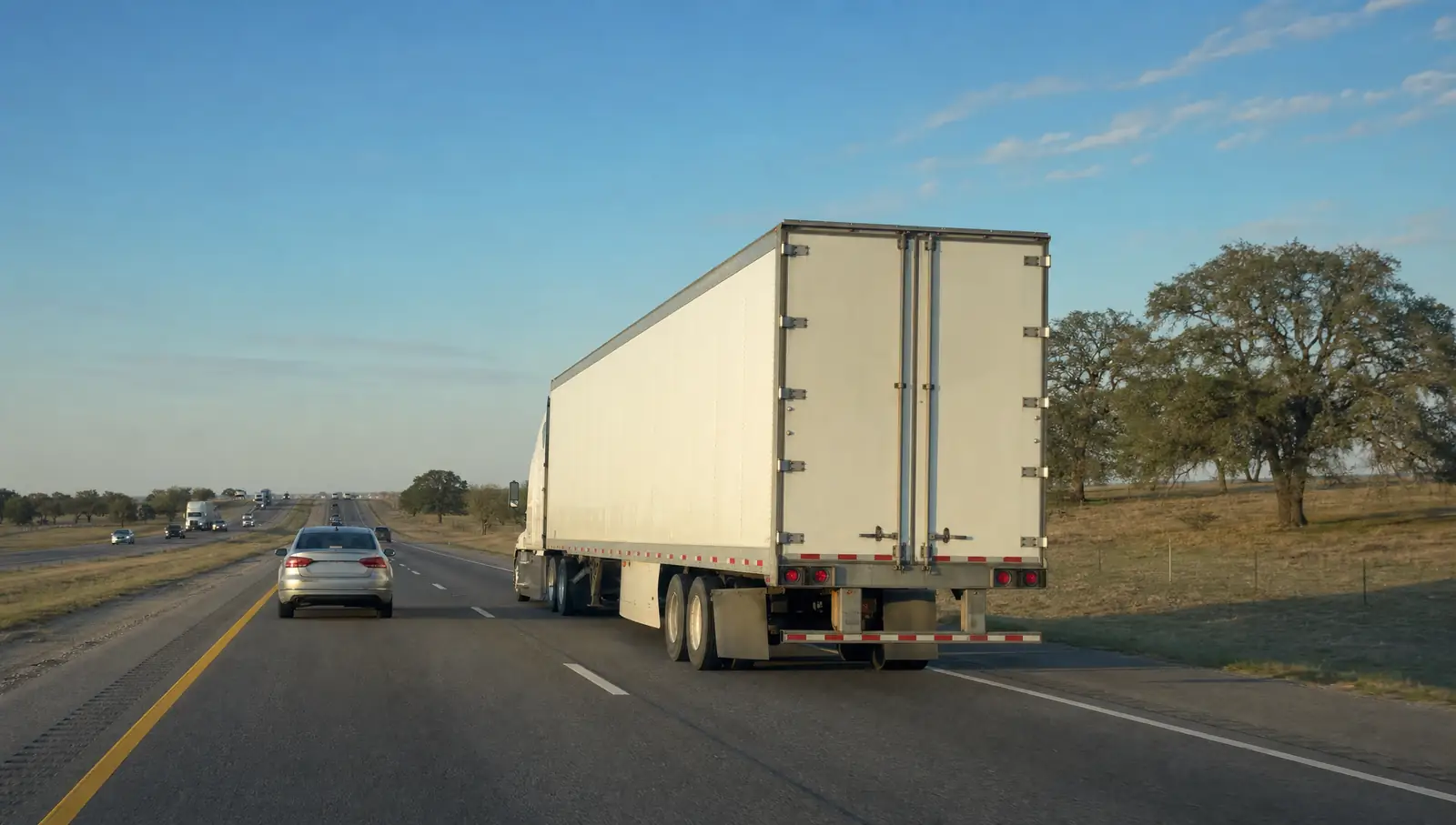
The blind spots are large
Truck drivers sit high and have big mirrors, and they still have four zones where a car can disappear:
- Directly in front, for about twenty feet. A car that cuts in close is below the windshield line.
- Directly behind, for around thirty feet. There is no rear window, and the mirrors look down the sides of the trailer.
- Along the left side, behind the cab door.
- Along the right side, which is the largest. It can cover two lanes and run most of the length of the trailer.
The working rule is simple. If you can't see the driver's face in the truck's side mirror, the driver can't see you.
It takes a long way to stop
At highway speed, a loaded truck in good condition on dry pavement needs something close to the length of two football fields to come to a stop. A car needs a good deal less. That gap is why truck drivers leave so much space ahead, and why that space fills with cars almost at once. Every car that slides into the gap shortens it, and the truck has to back off again.
The problem is worst where traffic bunches without warning: at the start of a merge, at an exit ramp backing onto the highway, and in lane shifts in a construction zone.
Wide right turns
A trailer cuts inside the path of the tractor on every turn. To make a right turn on a city street, the driver often has to swing out to the left first, or start the turn from the second lane. The open space on the right side looks like an invitation. It is the space the trailer is about to cross. If a truck has its right signal on and is drifting left, stay behind it.
Passing, and being passed
Pass on the left, where the driver has the better view, and don't linger alongside. Once you are past, wait until you can see the whole front of the truck in your rear-view mirror before moving back over. Then hold your speed. Braking just after cutting in front of a truck is how a following distance of two hundred feet turns into twenty.
When a truck is passing you, ease off slightly and keep right. On a two-lane road a truck needs a long, clear stretch to get by, and a car that speeds up halfway through makes it longer.
Weather and hills
In rain, trucks throw a wall of spray that hides everything around them for a second or two. Pass decisively or hang back. On steep climbs, loaded trucks slow to a crawl and may run with their flashers on. On the way down they may be holding a low gear and a steady speed, and they need you to leave them room.