Work Zones From the Cab
Orange barrels, a lane that disappears, and a crew a few feet from the travel lane. Here is how drivers who haul for a living read them.
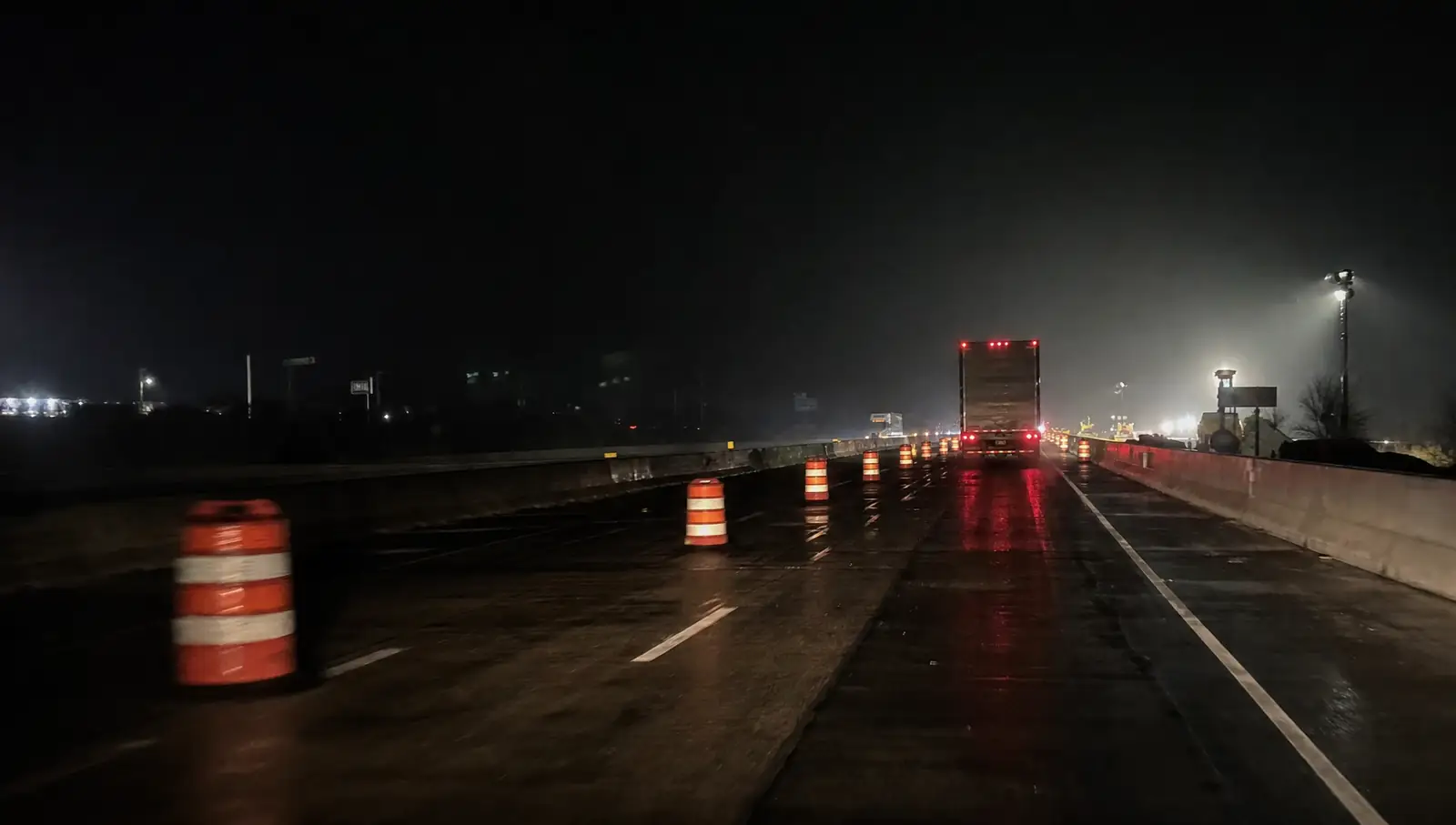
A road crew on an interstate works with traffic passing at arm's length. From a car, a work zone is a slowdown. From the seat of a truck that is eight and a half feet wide and seventy feet long, it is a problem in geometry that starts well before the first sign.
The first sign is the one that counts
Work zone signs usually start a mile or more ahead of the taper. That distance is there for vehicles like yours. A loaded truck needs room to shed speed without stabbing the brakes, and it needs a gap to merge into well before the lane ends. Drivers who have run a lot of construction seasons tend to merge early and then stay put. Fighting for position inside the taper is where trailers clip barrels and cars get squeezed.
The Federal Highway Administration's work zone program publishes a great deal on how these zones are designed. The short version for a driver is that every sign, drum and taper length assumes you started reacting at the first warning.
Narrow lanes and shifted lanes
A standard interstate lane is twelve feet wide. Work zones often run narrower, sometimes with a concrete barrier on one side and traffic on the other. A few habits help:
- Pick a reference point on the hood and keep it on the lane, since the mirrors will show you drifting later than you would like.
- Watch the trailer tandems in the mirror through any curve or shift. The trailer tracks inside the tractor's path, and the barrier does not move.
- Hold steady speed. Sudden braking inside a narrow zone invites the car behind into your blind spot.
- Expect old paint. In a lane shift, the stripes from the old pattern often show through, and at night the new path is the one marked by drums and reflectors.
People on the road
The crew is the reason the zone exists. Flaggers stand in the lane with a paddle and nothing else. Trucks backing in and out of the work area enter traffic slowly and without much warning. Equipment swings. The posted work zone limit is lower for these reasons, and in many states the fines double when workers are present.
A slower speed buys distance, and distance is the only thing that helps when a dump truck pulls out of the closure or a car ahead stops dead at the merge. A loaded truck at highway speed needs a long way to stop, which is laid out in more detail in the piece on the space a loaded truck needs to stop.
At night
A lot of interstate work happens after dark, when traffic is lighter. Night work zones are brighter than the road around them, with light towers aimed at the work, and those towers can wash out the view ahead for a few seconds as you pass. Slow down before the lights, not inside them. Watch for the crew's own vehicles, which often have amber lights that blend into the zone.
Leaving the zone
The end of a work zone is marked, and the temptation is to get back up to speed at once. Give it a few hundred feet. Cones get knocked into the lane, crews sometimes work right at the end of the closure, and the merge back to full lanes brings the same jockeying as the start. A work zone is a short stretch of road, and on most trips it costs a few minutes. For the people working there, it is the whole shift.