The Walk-Around Before the Key Turns
Fifteen minutes in the cold with a flashlight, done the same way every morning, is the cheapest part of a long haul.
Every driver learns the pre-trip inspection for the skills test, and most of them learn it as a speech. You point at a part, name it, say what you are checking it for, and move on. That version gets you a license. The version that keeps a truck out of trouble is quieter, faster and done the same way every morning, in the same order, whether the lot is dry or there is ice on the steps.
The order matters more than people expect. If you start at the same corner and walk the same loop, a missing step feels wrong before you can say why. Drivers who skip around tend to skip things.
Under the hood first
Engine off, parking brake set, wheels chocked if the yard is sloped. Check oil and coolant at the sight glass or dipstick, then look at what is around the engine rather than in it. A fresh drip on the frame rail, a belt with shiny edges, a hose that feels soft when you squeeze it. Power steering fluid gets a glance. So do the wires running to the alternator, because a chafed wire found in the yard costs ten minutes and the same wire found on the shoulder costs a day.
Steering and the front axle
Look at the steering box for leaks and at the tie rods and drag link for anything bent, loose or missing a cotter pin. Then the front suspension: springs, hangers, U-bolts and shocks. A broken leaf in a spring pack can sit there for weeks looking fine until it does not.
Tires and wheels, all of them
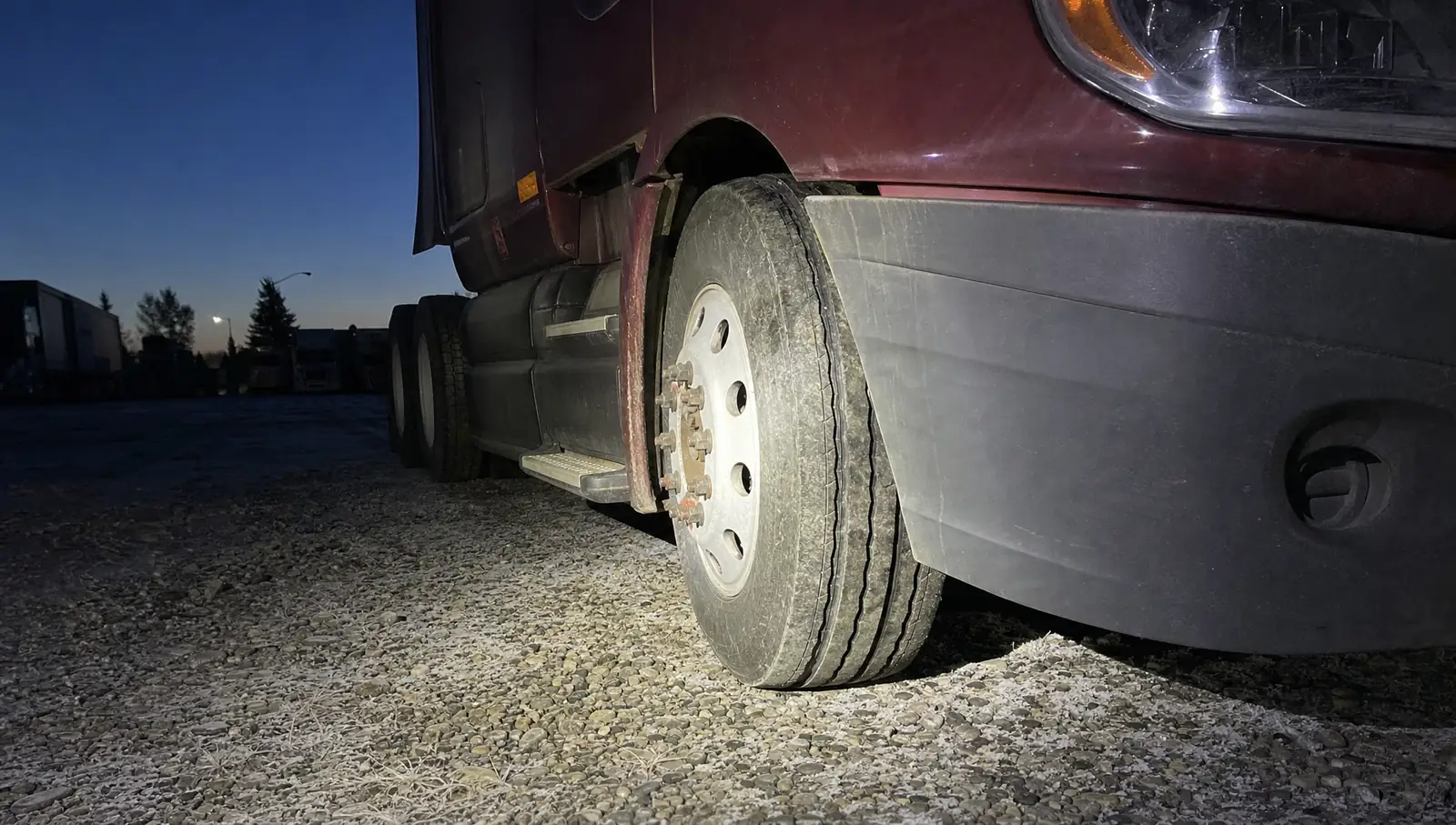
A loaded tractor-trailer can ride on eighteen tires, and every one of them gets the same attention.
- Tread depth. Steer tires need at least 4/32 of an inch in every major groove. Drive and trailer tires need 2/32.
- Sidewalls. Bulges, cuts down to the cords, and scuffs from a curb that went too far.
- Pressure. A thump with a bat tells you a tire is flat. It does not tell you a tire is twenty pounds low, so a gauge comes out at least once a day.
- Duals. Nothing wedged between them, and the two tires not touching each other.
- Lug nuts. Rust trails streaking away from a nut, or bright metal around it, can mean it has worked loose.
- Hub seals. Wet oil on the inside of the wheel is a seal that is leaking.
Brakes you can see
With the wheels in view, look at the brake chambers, the air lines feeding them and the slack adjusters. On a manual adjuster, a pushrod that travels too far when the brakes are applied is a brake that will fade sooner on a hill. Automatic adjusters still need checking, because when one stops adjusting it usually means something else in the brake is wrong. Brake drums and linings get a look through the inspection ports where the design allows it. If you have ever smelled hot brakes at the bottom of a pass, the reason this part gets slow, careful attention will be obvious, and the companion piece on brake adjustment on a long downgrade covers what happens when it does not.
The coupling
Crawl under far enough to see it properly. The fifth wheel jaws should be closed around the shank of the kingpin, not the head. The release arm should be in the locked position with the safety latch over it. There should be no space between the upper and lower fifth wheel plates. The air and electrical lines between tractor and trailer should hang free, without dragging, kinking or resting on the catwalk where they can chafe.
Lights and the air test
Turn on the four-way flashers and headlights and walk the whole rig again. Clearance lights, reflectors, turn signals, the plate light. Clean the lenses with a rag while you are there, since a dirty lens at night does the same job as a burned-out bulb.
Then the in-cab air brake check, done the way the manual describes it:
- With the engine running, the governor should cut out somewhere around 120 to 140 psi and cut back in around 100.
- Engine off, brakes released, a combination vehicle should not lose more than 3 psi in a minute. With the brakes held on, no more than 4.
- Pump the brakes down. The low-air warning should come on before pressure drops below 60 psi, and the spring brakes should set on their own somewhere between 20 and 45.
Finish with a slow tug test in low gear against the trailer brakes and the parking brake. If the truck pulls through either one, it stays parked.
Writing it down
The written report is the part people rush. It is also the part a mechanic reads, so "brake light out, driver side trailer" is more use than a tick in a box. A good inspection takes about fifteen minutes. Doing it well every morning takes a few hundred mornings of practice.